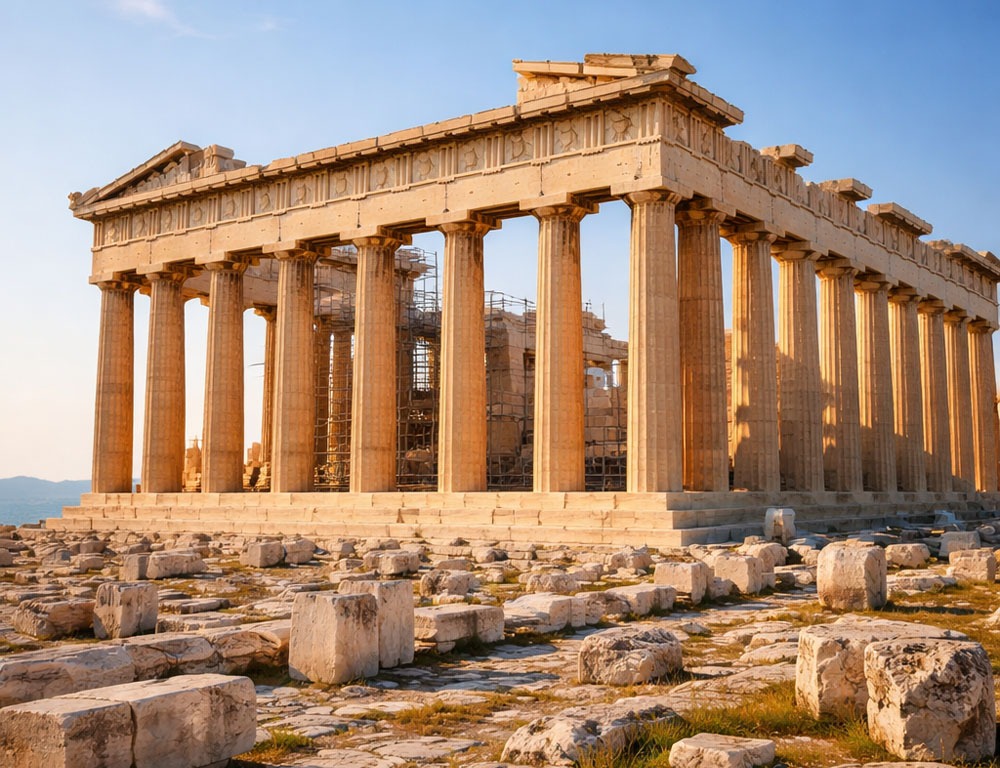
The Parthenon is an ancient Greek temple located on the Acropolis in Athens, Greece, built in the 5th century BCE. It was dedicated to Athena, the patron goddess of the city, and represents the peak of classical Greek architecture. Today, the ancient temple of Athena is one of the most famous monuments of ancient civilization and a symbol of Greek culture and democracy.
What is the Parthenon?
The Parthenon is a large ancient temple built in honor of the goddess Athena on the Acropolis of Athens. Constructed during the 5th century BCE, it represents one of the greatest achievements of classical Greek architecture.
The Parthenon was built between 447 and 432 BCE during the Golden Age of Athens. It served as both a religious sanctuary and a symbol of the power and cultural achievements of the city.
Located on the Acropolis, the temple dominates the skyline of Athens. Its harmonious proportions, refined design, and sculptural decoration made it one of the most influential architectural monuments in Western history.
The temple originally housed a massive statue of Athena, created from gold and ivory.
Why was the Parthenon built?
The Parthenon was built to honor Athena, the patron goddess of Athens, and to celebrate the city’s power after the Persian Wars.
Construction of the temple was part of a large building program initiated by the Athenian statesman Pericles. The project aimed to rebuild and beautify Athens after earlier temples had been destroyed during the Persian Wars.
The Parthenon served several purposes:
- a religious temple dedicated to Athena;
- a symbol of Athenian wealth and power;
- a treasury for the Delian League;
- a monument celebrating Greek victory over Persia.
The temple also reinforced Athens’ role as the cultural and political leader of the Greek world.
Who designed and built the Parthenon?
The Parthenon was designed by the architects Ictinus and Callicrates, with sculptural work supervised by the famous sculptor Phidias.
The architectural design of the temple was led by:
- Ictinus;
- Callicrates.
The artistic program, including sculptures and decorative reliefs, was supervised by the renowned sculptor Phidias.
Their collaboration produced one of the most sophisticated architectural works of the ancient world.
Materials and construction
Ancient Greek builders constructed the Parthenon primarily from Pentelic marble, a high-quality stone quarried near Athens. Thousands of workers, artisans, and sculptors participated in the construction.
Key architectural features include:
- Doric columns;
- refined optical corrections;
- elaborate sculptural decorations;
- symmetrical proportions.
These innovations helped create the temple’s distinctive visual harmony.
What makes the Parthenon architecturally unique?
The Parthenon is unique because of its precise proportions, optical corrections, and combination of Doric and Ionic architectural elements.
Architects designed the temple to measure approximately 69.5 meters in length and 30.9 meters in width and surrounded it with 46 outer columns.
One of the most remarkable aspects of the Parthenon is its use of optical refinements. Ancient Greek architects intentionally altered the geometry of the building to make it appear perfectly straight to the human eye.
Examples include:
- slightly curved stylobate (temple base);
- columns that lean inward;
- thicker corner columns;
- subtle column curvature known as entasis.
These design adjustments prevent visual distortions and create the illusion of perfect symmetry.
Architectural style
| Feature | Description |
|---|---|
| Order | Doric with Ionic elements |
| Material | Pentelic marble |
| Columns | 8 front columns, 17 side columns |
| Construction period | 447–432 BCE |
| Location | Acropolis of Athens |
The combination of mathematical precision and artistic beauty made the Parthenon a model for many later buildings across Europe and the United States.
What sculptures decorated the Parthenon?
The Parthenon featured extensive sculptures, including pediments, metopes, and a continuous frieze depicting mythological and religious scenes.
The sculptural decoration was among the most elaborate in ancient Greece.
Main sculptural elements
- Pediments
Large triangular sculptures at each end of the temple depicting mythological scenes. - Metopes
Square panels carved with dramatic mythological battles, such as:- Greeks vs. Amazons;
- gods vs. giants;
- Greeks vs. centaurs.
- Frieze
A continuous relief running along the inner walls of the temple showing the Panathenaic procession, a major religious festival in Athens.
Museums such as the Acropolis Museum and the British Museum now preserve many surviving Parthenon sculptures.
How has the Parthenon changed over time?
Over centuries, the Parthenon served as a temple, church, mosque, and fortress before becoming an archaeological monument.
The history of the building reflects the changing political and religious landscape of Athens.
Timeline of the Parthenon
| Period | Use |
|---|---|
| Classical Greece | Temple dedicated to Athena |
| Byzantine era | Christian church |
| Ottoman rule | Mosque |
| 1687 | Damaged during Venetian bombardment |
| Modern era | Archaeological monument and restoration site |
The most severe damage occurred in 1687, when a Venetian attack caused an explosion that destroyed much of the structure.
Today, extensive restoration projects aim to stabilize and preserve the temple.
Why is the Parthenon important today?
The Parthenon remains one of the most important symbols of ancient Greek civilization and Western cultural heritage.
Its significance extends beyond architecture.
Key reasons the Parthenon matters today:
- it represents the Golden Age of Athens;
- it influenced architecture worldwide;
- it symbolizes democracy, philosophy, and art;
- it is one of the most recognized historical monuments globally.
The Parthenon is part of the UNESCO World Heritage Site that includes the Acropolis.
Millions of visitors travel to Athens each year to see the temple and learn about ancient Greek history.
Conclusion: The Historical Importance of the Parthenon
Ancient Athenians built the Parthenon as a monumental temple to honor the goddess Athena and celebrate the cultural achievements of classical Greece. Today, it remains one of the most important historical landmarks in the world and a powerful symbol of ancient architecture, art, and democracy.