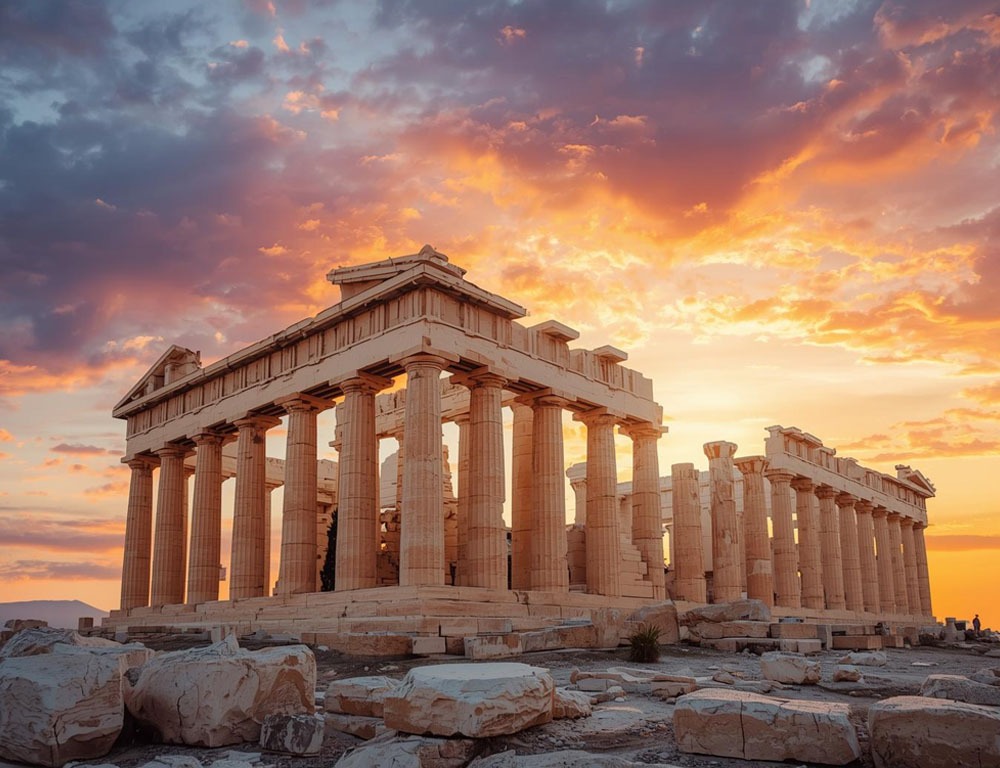
The Acropolis is an ancient citadel located on a rocky hill in Athens, Greece, famous for its classical temples and historical importance. Built mainly during the 5th century BCE, it served as a religious and political center of ancient Athens. Today, it is one of the most important archaeological sites in the world and a symbol of ancient Greek civilization.
What is the Acropolis?
The Acropolis is an ancient fortified hilltop complex in Athens that contains several historic buildings, including the Parthenon. It was the religious and cultural center of the ancient Greek city-state.
The word “Acropolis” comes from Greek: akron (highest point) and polis (city). Many ancient Greek cities had an acropolis, but the most famous one is the Acropolis in Athens.
This elevated limestone hill rises about 150 meters (490 feet) above sea level and overlooks the city. Because of its strategic location, it was originally used as a fortified settlement and refuge during attacks.
Over time, the Athenian Acropolis evolved into a religious sanctuary dedicated primarily to the goddess Athena, the patron deity of Athens.
Where is the Acropolis located?
The Acropolis is located in the historic center of Athens, Greece, above the neighborhoods of Plaka and Monastiraki.
The hill dominates the skyline of Athens, making it visible from many parts of the city. Its elevated position helped ancient Athenians defend their city and build monumental temples visible from far away.
Geographic overview:
| Feature | Description |
|---|---|
| City | Athens |
| Country | Greece |
| Elevation | About 150 m (490 ft) |
| Type | Ancient citadel and archaeological site |
| UNESCO Status | World Heritage Site (since 1987) |
The ancient citadel sits at the center of the ancient city and historically connected to important civic spaces like the Ancient Agora, where public meetings and markets took place.
Why was the Acropolis built?
The Acropolis was built as a defensive stronghold and later became the religious center of ancient Athens.
The earliest settlements on the ancient hilltop fortress date back to the Bronze Age (around 3000 BCE). Initially, the hill served primarily as a fortress due to its steep cliffs and strategic height.
During the Golden Age of Athens in the 5th century BCE, the site was transformed into a monumental sanctuary under the leadership of Pericles.
Major construction projects during this period included:
- temples dedicated to Athena;
- ceremonial gateways;
- sacred statues and monuments.
The goal was not only religious but also political. The buildings demonstrated the power, wealth, and artistic achievements of Athens during its classical period.
What buildings are on the Acropolis?
The most important buildings on the Acropolis include the Parthenon, Erechtheion, Temple of Athena Nike, and the Propylaea.
These structures represent some of the greatest achievements of classical Greek architecture.
Main structures on the Acropolis
- Parthenon. The largest and most famous temple, dedicated to the goddess Athena. Built between 447 and 432 BCE, it represents the peak of classical Greek architecture.
- Erechtheion. Known for its famous Caryatid columns shaped like female figures.
- Temple of Athena Nike. A small but elegant temple dedicated to Athena as the goddess of victory.
- Propylaea. The monumental gateway that forms the main entrance to the historic citadel.
These buildings were designed by leading architects and sculptors of the time, including Phidias, who oversaw the artistic program.
Why is the Acropolis important?
The Acropolis is important because it represents the cultural, political, and artistic achievements of ancient Greece.
The site played a central role in the development of democracy, philosophy, architecture, and art.
Key reasons the classical Greek citadel matters:
- It symbolizes the Golden Age of Athens;
- It contains masterpieces of classical Greek architecture;
- It influenced architecture across Europe and the world;
- It is a major source of knowledge about ancient Greek religion and society.
In 1987, the Acropolis was designated a UNESCO World Heritage Site, recognizing its universal historical significance.
Today, it remains one of the most visited archaeological sites in Europe.
When was the Acropolis built?
Most of the iconic buildings on the Acropolis were constructed during the 5th century BCE.
However, the history of the hill is much older.
Timeline of the Acropolis:
| Period | Key Developments |
|---|---|
| Bronze Age (3000–1100 BCE) | Early settlements and fortifications |
| Archaic Period (700–480 BCE) | First temples built |
| Classical Period (447–432 BCE) | Construction of Parthenon and major monuments |
| Roman Period | Site preserved and restored |
| Ottoman Period | Used as fortress and mosque |
| Modern Era | Archaeological preservation and restoration |
Modern restoration projects continue to protect and stabilize the ancient structures.
What can visitors see at the Acropolis today?
Visitors can explore ancient temples, archaeological ruins, and panoramic views of Athens.
The Acropolis is now an open-air archaeological park that attracts millions of visitors each year.
Highlights of a visit include:
- Walking through the Propylaea entrance.
- Seeing the Parthenon up close.
- Viewing the Caryatids of the Erechtheion.
- Enjoying panoramic views of Athens.
- Visiting the nearby Acropolis Museum.
The museum houses original sculptures, artifacts, and architectural fragments discovered on the Acropolis.
The Acropolis is an ancient hilltop citadel in Athens that served as the religious and cultural center of the city. Today it stands as one of the most important monuments of ancient Greek civilization and a global symbol of classical architecture, history, and democracy.